
What If You’re Wrong? The Wisdom We’ve Lost in a World That Has to Be Right
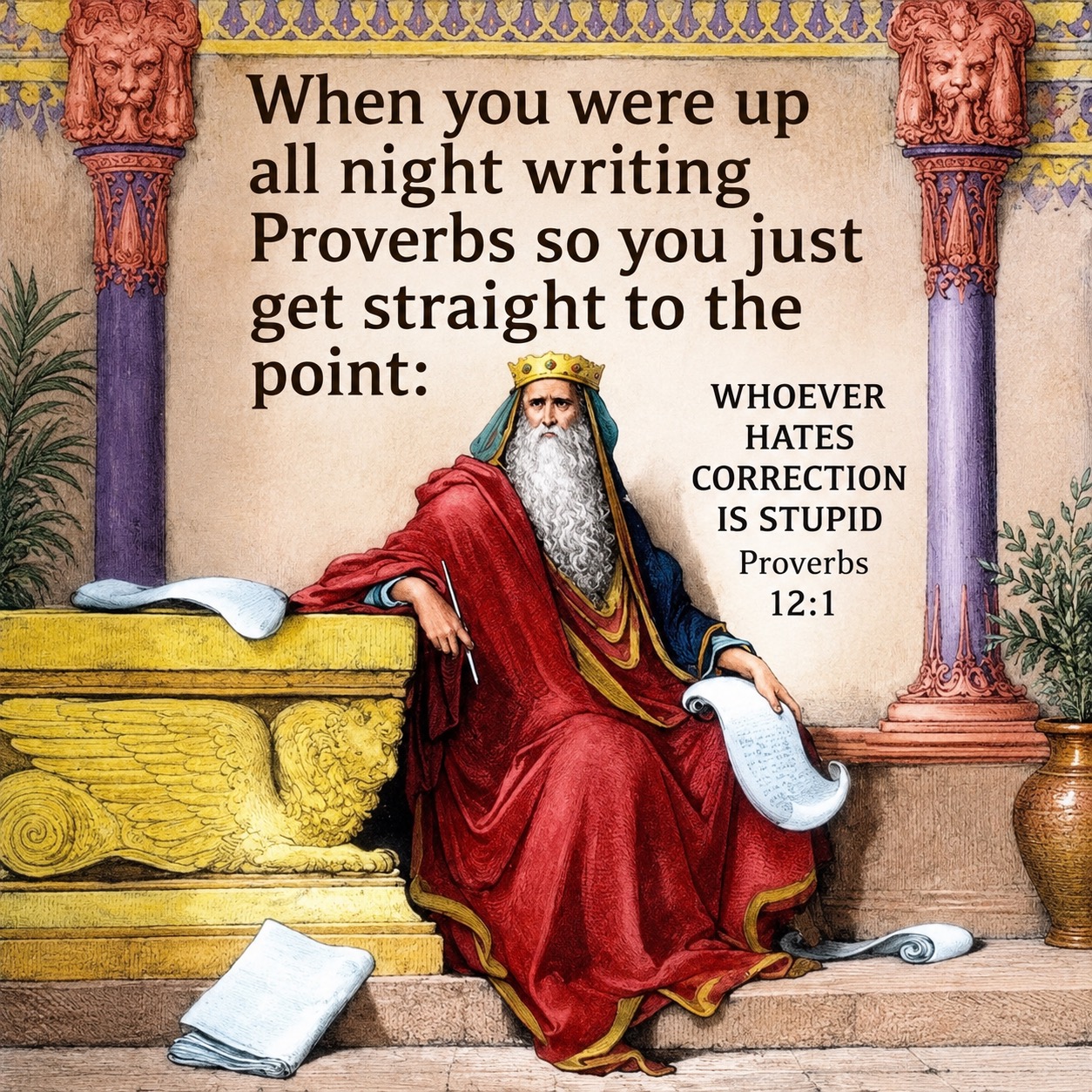
I saw a funny meme recently about Proverbs 12:1: “Whoever loves discipline loves knowledge, but whoever hates correction is stupid.” It made me laugh because there is absolutely no sugarcoating that verse. Depending on the translation, you’ll find the word stupid or something similar, but the message is pretty clear: if you cannot handle correction, you cannot grow in wisdom. #yastupid
That got me thinking about the world we live in today.
We seem to be living in a society full of people who are absolutely convinced they are right. Not possibly right. Not “this is what I believe based on what I know today.” But right. Period. And if you disagree with them, then obviously you must be uninformed, ignorant, deceived, or just plain wrong. It’s like most people have lost the ability to say, “Maybe I don’t know everything.” And social media hasn’t helped. We can open our phone. or laptop and find an endless stream of people, articles, videos, podcasts, and posts reinforcing almost anything we already believe. The more we engage with something, the more we are fed similar content. Before long, we aren’t necessarily seeing the whole world; we’re seeing a version of the world filtered through an algorithm.
That can be dangerous, not because having strong convictions is wrong, but because having your opinion constantly affirmed can easily be mistaken for being constantly right. Don’t misunderstand me, there is a difference between conviction and pride. Conviction says, “This is what I believe to be true.” Pride says, “And therefore I have nothing left to learn.” The Bible is clear as to why this way of thinking is wrong. Proverbs 18:2 says, “A fool takes no pleasure in understanding, but only in expressing his opinion.” Crazy huh? Thousands of years before social media even existed, Scripture was already warning us about the human tendency to care more about expressing our opinions than actually understanding someone else’s. Maybe social media didn’t create this problem, maybe it simply gave the age old human ego a platform and microphone.
Pride has always existed. Ego has always existed. The desire to be right has always existed. Social media just gives us the ability to surround ourselves with people who agree with us, block the people who don’t, and receive instant affirmation from hundreds or thousands of strangers that our opinion is right. And many have become so accustomed to hearing their own beliefs repeated back to them that disagreement feels like disrespect. But disagreement isn’t necessarily disrespect and correction isn’t necessarily criticism. Sometimes correction is actually a gift.
Proverbs 15:31–32 says, “Whoever heeds life-giving correction will be at home among the wise. Those who disregard discipline despise themselves, but the one who heeds correction gains understanding.”
Notice how Scripture connects the ability to receive correction with wisdom and understanding. That requires humility and humility isn’t thinking poorly of ourselves or allowing everyone else’s opinion to control us. It is simply having enough wisdom and security in yourself, to admit, “I could be wrong about this.” It means listening long enough to understand another person’s perspective before deciding whether we agree with it. I don’t think Jesus ever wants us to get to place in our life where we no longer can be taught.
Proverbs 12:15 says, “The way of fools seems right to them, but the wise listen to advice.” Think about those words: seems right to them. Something we can feel completely right and still be wrong. Our certainty isn’t proof that we are absolutely right. I have been wrong plenty of times in my life. I’ve misunderstood people, I’ve reacted emotionally, I’ve formed opinions without knowing the whole story, I’ve believed things strongly and later realized there was another perspective I hadn’t considered. I’VE BEEN STUPID. But as I’ve matured I realize now those moments were not failures because I allowed myself to learn from them. In many ways, being wrong has taught me far more than being right ever could. Mistakes have a way of humbling us. Correction can expose blind spots we couldn’t see ourselves. Another person’s perspective can show us something our own experiences simply can’t. But none of that happens if our first response to correction is defensiveness.
Proverbs 9:8–9 gives us another comparison: “Do not rebuke mockers or they will hate you; rebuke the wise and they will love you. Instruct the wise and they will be wiser still.” That verse challenges me because it suggests that one of the marks of wisdom isn’t how much we already know. It’s how teachable I am.
I want to be wise, don’t you? So maybe the better question isn’t, “Am I right?” Maybe it’s, “Am I still teachable?”
Can I listen to someone whose life experiences are different from mine? Can I hear something uncomfortable without immediately becoming defensive? Can I accept disagreement without feeling like I’ve been personally attacked? Can I consider the possibility that someone else may see something I don’t? And perhaps the hardest question of all: Can I discover that I was wrong without feeling like it somehow insulted my intelligence?
There is a quote by CS Lewis that I love –“What you see and what you hear depends a great deal on where you are standing. It also depends on what sort of person you are” Are you the kind of peon who is mature enough to realize we’ve all stood in different places in life. We had different upbringings, different hurts, different privileges different living environments, parents and lifestyles.
Changing your mind because you heard another viewpoint from a person who has stood in a deferent spot in life than you isn’t weakness. Admitting you made a mistake isn’t weakness. Saying “I was wrong” isn’t weakness. I personally think that is one of the most admirable qualities in a person! Admitting you’re wrong takes maturity. James 1:19 tells us to be “quick to listen, slow to speak and slow to become angry.” Imagine what our families, marriages, workplaces, churches, politics, and social media feeds might look like if we actually lived that way. Quick to listen? Slow to speak? Not desperately trying to win every conversation, but genuinely trying to understand the other person.
We can have our personal convictions and not agree with every opinion. Some things are worth standing firmly for and I have those convictions that nobody is going to change. But we can have a strong conviction and a teachable spirit. In fact, I think we should. There will always be more for us to learn. ALWAYS. There will always be perspectives we haven’t considered. ALWAYS. There will always be blind spots we cannot see without someone else helping us see them. ALWAYS
So perhaps before we immediately defend ourselves the next time someone challenges us, we could ask one simple question:
Is there something in what this person is saying that could possibly teach me something?
We may ultimately decide they’re wrong. But every once in a while, we may discover that we are.